

Horse Blanket Sizes: The Complete Measuring & Fit Guide for 2026
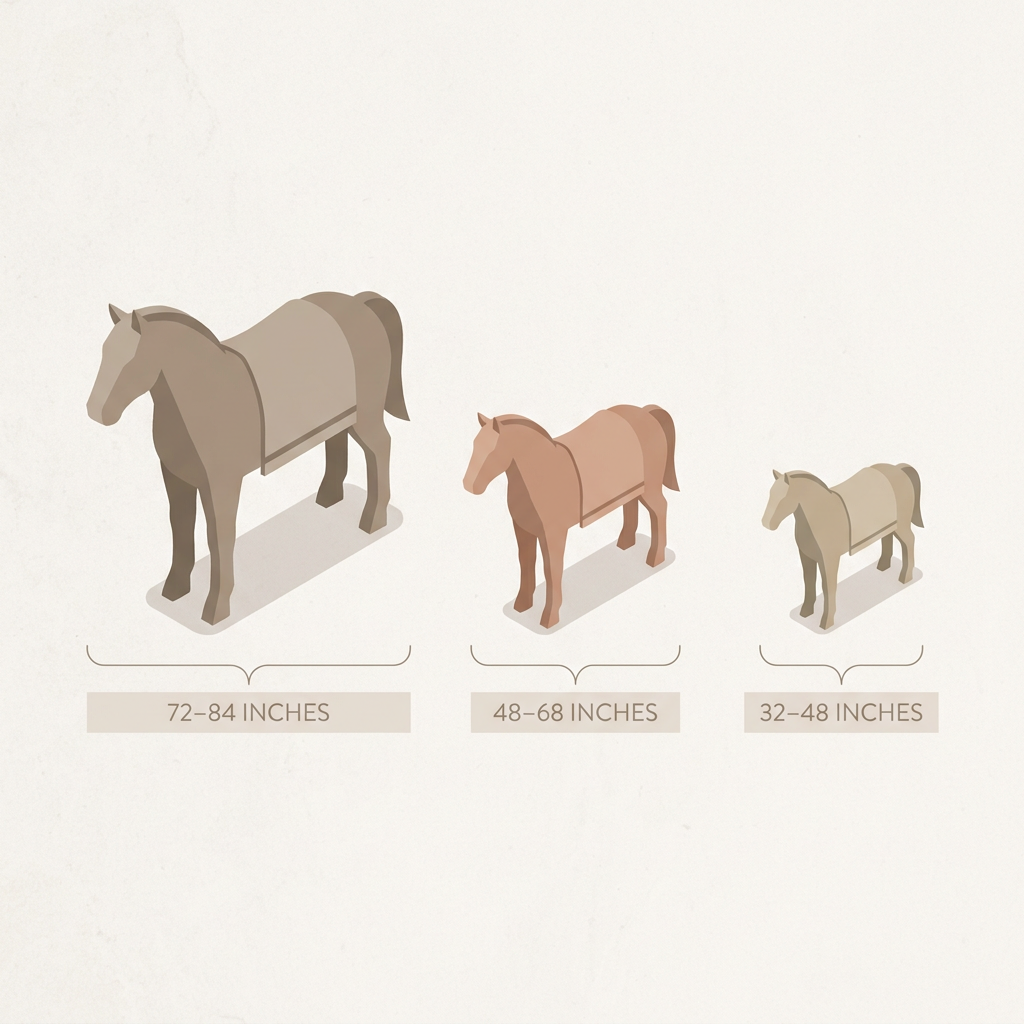
Getting your horse's blanket size right is simpler than you think. Measure from the center of the chest to the center of the tail in a straight horizontal line. That single number (in inches) is your blanket size. Most adult horses fall between 72" and 84", ponies between 48" and 68", and minis between 32" and 48".
Measuring is just step one, though. A blanket that's the right length can still fit terribly if it's too narrow in the shoulders, too loose at the belly, or cut for a completely different body type than your horse. That's where most horse owners run into trouble.
This guide covers how to measure, how to read a size chart, what to do when your horse falls between sizes, and how to get a good fit on drafts, ponies, minis, and donkeys. By the end, you'll know exactly what to buy and what to look for.
Quick Reference: Horse Blanket Sizing at a Glance
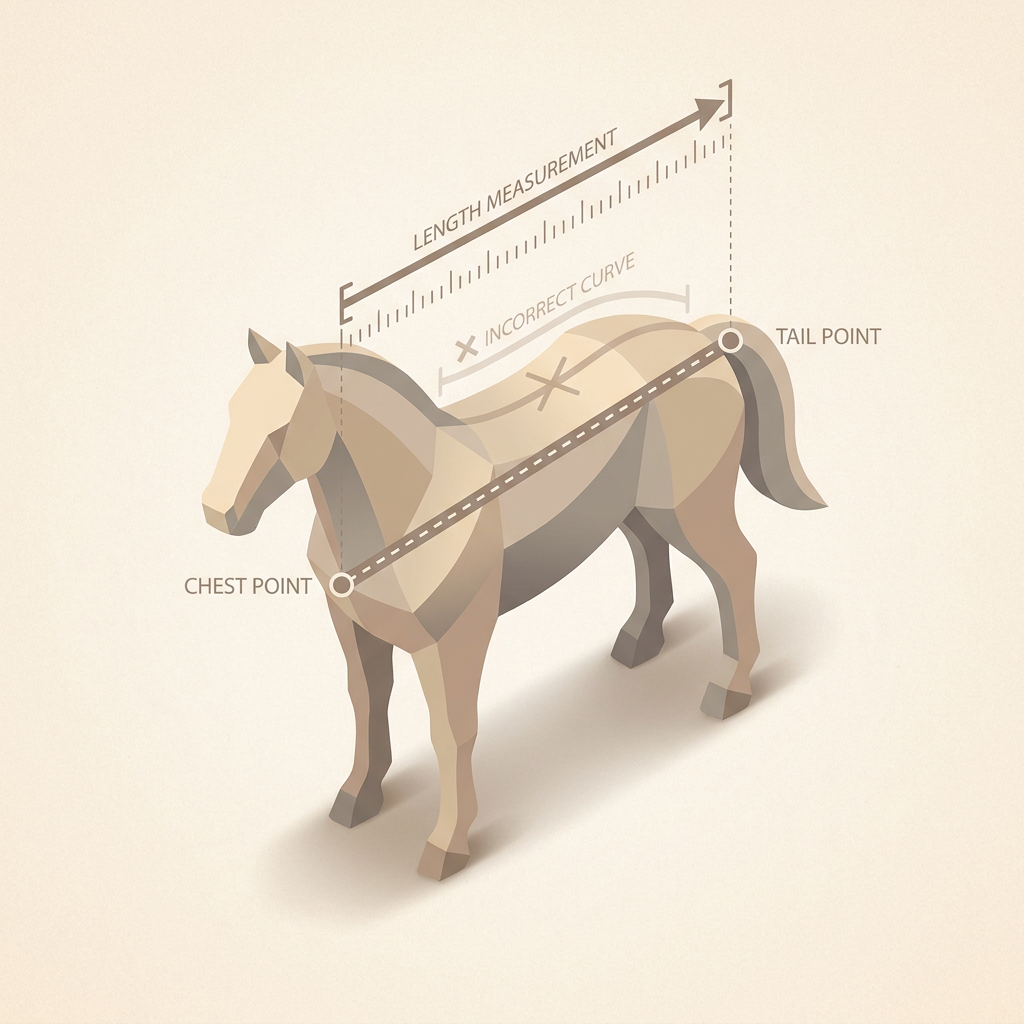
- Measure chest-to-tail in a straight line (not along the curve of the body)
- Most adult horses need a 72" to 84" blanket
- When between sizes, always size UP, then adjust straps
- Draft horses may need 80" to 90"+ or a specialty cut
- Fit matters as much as size: shoulder room is the #1 fit problem
Table of Contents
- Why horse blanket size matters more than you think
- How to measure your horse for a blanket
- Horse blanket size chart for standard horses
- Blanket sizes for draft horses
- Blanket sizes for ponies and miniature horses
- Blanket sizes for donkeys and mini donkeys
- How to tell if your blanket actually fits
- Does your fly sheet size match your blanket size?
- Understanding fill weights and warmth levels
- FAQ
Why Horse Blanket Size Matters More Than You Think
We've all seen it. A horse standing in the paddock with a blanket sliding to one side, a chest strap barely holding things together, and a neckline rubbing a bald patch on the shoulder. It looks uncomfortable. And honestly, it is.
An ill-fitting blanket isn't just a cosmetic problem. Blankets that are too narrow across the shoulders can cause chronic muscle tension in the trapezius and shoulder region, tight neck openings restrict movement, and loose belly straps are a leg-entanglement waiting to happen. These are real welfare issues.
One industry survey found that roughly 60 to 70 percent of horse owners are using incorrectly fitted blankets, with most running too small across the chest or shoulders. That's a staggering number, and it's completely fixable once you know what to look for.
The American Association of Equine Practitioners (AAEP) also points out that over-blanketing (using too heavy a fill for the conditions) is just as harmful as under-blanketing. A hot, sweaty horse who then chills when temperatures drop overnight is a horse at real risk. Size AND fill weight both matter.
How to Measure Your Horse for a Blanket
This is the part people overcomplicate. It's actually pretty straightforward.
What you need: A soft fabric tape measure. A helper if your horse is wiggly.
Step 1: Stand your horse square on level ground.
Step 2: Place the end of the tape at the center of your horse's chest, right at the point of the breast.
Step 3: Run the tape in a straight, horizontal line along the side of the body to the center of the tail. Don't follow the curve of the rump. Keep it level.
Step 4: That number, in inches, is your horse's blanket size.
Per SmartPak's blanket measuring guide, if your horse measures between sizes, you always round UP to the next size. A slightly longer blanket with adjusted straps is always better than one that's too short and pulling across the shoulders.
One more thing worth doing: measure your horse at least once a year. Seniors, hard keepers, horses in heavy training, and horses recovering from injury can shift significantly in body condition from season to season. A blanket that fit perfectly last winter might be pinching this year.
Horse Blanket Size Chart for Standard Horses
Here's a general reference chart for adult horses. Keep in mind that breed conformation, body condition, and individual build all affect fit beyond raw length.
| Horse Type / Height | Typical Blanket Size |
|---|---|
| Small pony (under 12 hh) | 48" to 58" |
| Medium pony (12–13.2 hh) | 58" to 66" |
| Large pony / small horse (13.2–14.2 hh) | 66" to 72" |
| Average horse (14.2–15.2 hh) | 72" to 78" |
| Larger horse (15.2–16.2 hh) | 78" to 82" |
| Big horse (16.2–17+ hh) | 82" to 86" |
| Warmblood / large frame (17+ hh) | 84" to 90" |
| Draft horse | 84" to 90"+ |
A few things worth noting here. Thoroughbreds and warmbloods often need more shoulder room than their raw measurement suggests, because of how their shoulders are built. A measuring tape doesn't capture shoulder angle. When in doubt, go up a size and use the chest and surcingle straps to fine-tune the fit.
Quarter Horses and stockier breeds tend to fit standard sizing more predictably. But every horse is an individual, so always check the actual fit after putting the blanket on.
Blanket Sizes for Draft Horses
Draft horse owners know this struggle well. Most mainstream brands stop at 84" or 86", leaving Clydesdale, Percheron, and Belgian owners with very few options.
Draft horses typically need blankets in the 80" to 90"+ range. Some larger individuals need custom sizing or specialty cuts designed specifically for the draft build: wider necks, broader chests, and more barrel depth than a standard horse of the same length.
Kensington's draft horse collection is built specifically for these bigger animals. It's not just a scaled-up version of a standard horse blanket. The cut accounts for the differences in draft conformation that make standard blankets bunch, bind, and slip.
Pay close attention to neck circumference too. A 84" blanket from a brand designed for Thoroughbreds will often have a neck opening that's simply too narrow for a draft, even if the length is right. A 84" from one company can differ by 3 to 5 inches in neck circumference compared to another brand's 84", so always check the brand-specific fit chart.
Blanket Sizes for Ponies and Miniature Horses
Ponies and miniature horses aren't just small versions of a full-sized horse. Their proportions are often quite different, and they deserve a blanket that's actually designed for their build.
Ponies generally need blankets in the 48" to 68" range. A 13-hand Welsh Cob built like a little tank is going to need a very different fit than a slender 13.2-hand Arabian cross. Miniature horses need blankets in the 32" to 48" range, and at this size, proportional fit matters even more because there's very little room for adjustment. A blanket that's too long on a mini can become a tripping hazard.
Kensington's miniature horse collection is built for these smaller animals, with sizing and strap placement that actually works on a compact frame. Use the same chest-to-tail measurement method for minis as you would for any horse.
For foals and young horses, plan to resize frequently. In the first two years, a growing horse can add 4 to 8 inches of blanket size per year.
Blanket Sizes for Donkeys and Mini Donkeys
Here's the thing about donkeys: they are not shaped like horses. A standard horse blanket on a donkey looks like a disaster waiting to happen.
Donkeys have a more upright shoulder, a narrower and more defined wither, and a different belly profile altogether. A horse-sized blanket will slide all over the place and never stay where it should. Standard donkeys typically fall in the 60" to 72" range, but the fit around the neck and shoulders is where things get tricky. Mini donkeys are usually in the 32" to 48" range.
Kensington's mini donkey collection includes gear designed around actual donkey anatomy, which makes a real difference in how well protection products stay in place and do their job. Measure the same way you would for a horse (chest to tail), but pay extra attention to neck circumference and shoulder width when evaluating fit.
How to Tell If Your Blanket Actually Fits
You've measured. You've ordered the right size. You put it on. Now what?
Run through this quick fit checklist every time you put a new blanket on your horse.
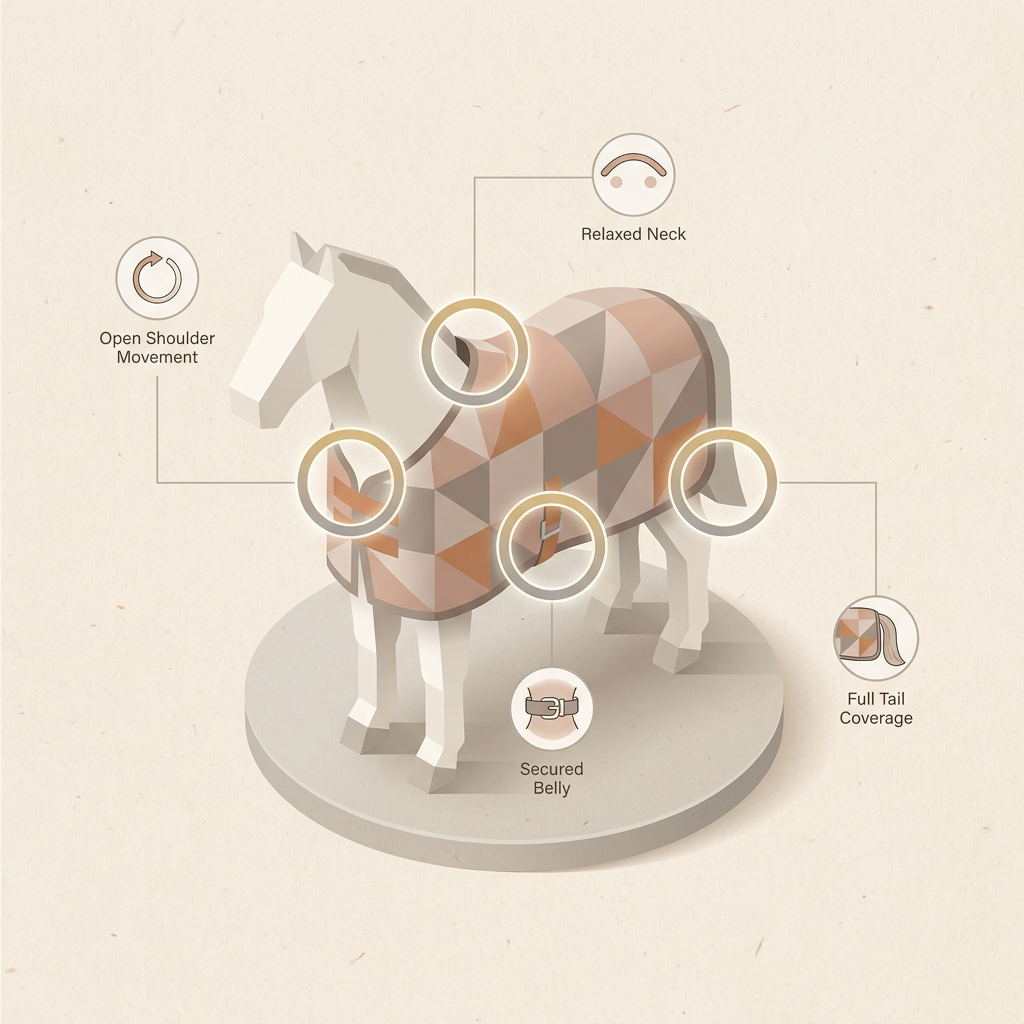
Shoulders: You should be able to slip two fingers flat under the edge of the blanket at the shoulder. If the fabric is pulling or creating a ridge in the hair, the blanket is too narrow. Shoulder rubs are the #1 sign of a too-tight blanket.
Withers: The blanket should ideally be just in front of the withers. If it's pressing down on the withers, you'll end up with sores and hair loss fast.
Neck opening: Snug enough to stay in place, but not so tight that it's restricting movement or leaving marks on the neck.
Belly and surcingle straps: Cross surcingles should hang loosely enough that you can fit a fist between the strap and your horse's belly. Too tight restricts movement and breathing; too loose is a leg-entanglement risk.
Tail flap: Should cover the top of the tail and protect the hindquarters without dangling so far down it catches on things.
Does it stay put? Have your horse walk, trot, and roll if possible. A well-fitted blanket moves with the horse and returns to position.
If your horse has high withers, a short back, or an unusually wide shoulder, standard sizing may just not work. In those cases, sizing up and using a belly band to keep the blanket from sliding forward can make a real difference.
For blankets that develop small issues over time, Kensington's guide on how to repair horse sheets and blankets has practical DIY fixes that can extend the life of a well-fitting blanket for years.
Does Your Fly Sheet Size Match Your Blanket Size?
This question comes up constantly. The short answer is: usually yes, but not always.
If your horse wears a 78" Kensington fly sheet, that's a solid starting point for finding their winter blanket size. The chest-to-tail measurement is the same, and the fundamental fit principle is the same.
What changes is the build of the product. A protective fly sheet is designed for warm weather and lighter movement. A winter turnout blanket needs to handle more movement, heavier fill, and different weather stress. Brands sometimes cut their winter blankets slightly differently than their summer sheets to accommodate fill bulk.
Start with your fly sheet size, then check the specific blanket brand's fit chart. If your fly sheet fits perfectly at 78", your blanket will almost certainly be a 78" too. Just double-check shoulder and neck dimensions if you're switching brands.
Still shopping for a fly sheet? Kensington's guide on the 5 best fly sheets for pasture horses in 2026 is a great place to start. You'll find a fly sheet that fits well AND have a reliable size reference ready for blanket season.
Understanding Fill Weights and Warmth Levels
Size and fit get the blanket on correctly. Fill weight determines whether your horse is actually warm enough.
Here's a simple breakdown:
| Fill Weight | Warmth Level | Best For |
|---|---|---|
| 0g (no fill) | Sheet only | Cool nights, UV/rain protection |
| 100–150g | Lightweight | 30°F to 50°F (-1°C to 10°C) |
| 200–250g | Medium | 10°F to 30°F (-12°C to -1°C) |
| 300–400g | Heavyweight | Below 0°F (-18°C) or clipped horses |
Horses with thick winter coats need less blanketing than clipped horses. A clipped horse needs significantly more fill to compensate for the coat they've lost. Senior horses and hard keepers may also need heavier fill than a healthy horse of the same size.
And remember what the AAEP points out: over-blanketing causes sweating, which leads to chilling when temperatures drop overnight. Matching fill weight to actual conditions is just as important as getting the size right.
FAQ
Q: Do horse blanket sizes vary between brands? Yes, significantly. A 78" blanket from one brand can differ by 3 to 5 inches in neck circumference, shoulder width, and tail flap depth compared to another brand's 78". Always check the specific brand's sizing chart. Your measurement is your starting point, not the finish line.
Q: Can I use my horse's fly sheet size to figure out their blanket size? Yes, it's a reliable starting point. The same chest-to-tail measurement applies to both. Just verify the specific blanket brand's fit chart before ordering, since construction differences between summer sheets and winter blankets can affect overall fit.
Q: How do I know if my horse's blanket is too small? The clearest signs are shoulder rubs (bare patches or hair loss at the point of the shoulder), a blanket that constantly slides backward, and a neck opening that leaves marks. If the fabric is pulling visibly across the chest or restricting shoulder movement, go up a size.
Q: Do I need to re-measure my horse every year? It's a good idea, especially for seniors, horses in heavy training, and horses recovering from illness or injury. Body condition changes of even one score can affect how a blanket fits. An annual measurement takes two minutes and can save you a whole winter of dealing with a poorly fitting blanket.
Q: What size blanket does a mini donkey need? Most mini donkeys fall in the 32" to 48" range, but standard sizing from horse-focused brands rarely fits donkey anatomy well. Donkeys have a different shoulder and neck build than horses, so look for gear that's specifically designed for them. Kensington's mini donkey collection is built to fit donkey anatomy properly, so protection actually stays in place and does its job.